[컴선설] Lec 11 Subdivision and Degree Elevation of Bezier Curve
LN11. Subdivision and Degree Elevation of Bézier Curve
1. Subdivision / Clipping Bézier Curve
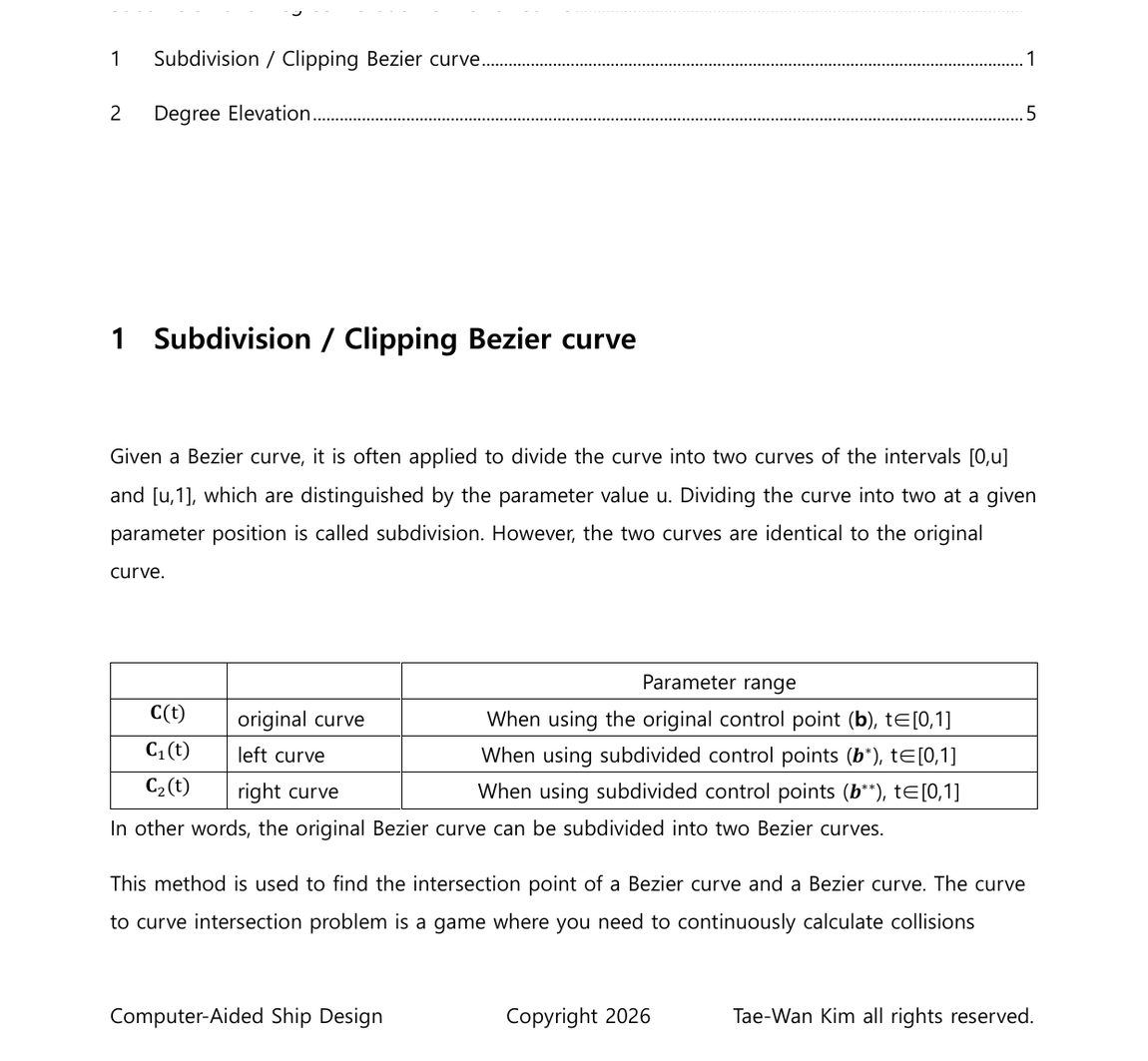
Given a Bézier curve
\[\mathbf{C}(t) = \sum_{i=0}^{n}\mathbf{b}_{i}B_{i}^{n}(t), \qquad 0\le t\le1\]subdivision at parameter $u$ divides it into
- a left curve over $[0,u]$,
- a right curve over $[u,1]$.
The two new curves have different control points but reproduce the original geometry exactly.
de Casteljau Construction
Set
\[\mathbf{b}_{i}^{0}=\mathbf{b}_{i}\]and recursively compute
\[\mathbf{b}_{i}^{r} = (1-u)\mathbf{b}_{i}^{r-1} +u\mathbf{b}_{i+1}^{r-1}\]for
\[r=1,2,\ldots,n\]The point at the subdivision parameter is
\[\mathbf{C}(u)=\mathbf{b}_{0}^{n}\]Left control points
\[\left\{ \mathbf{b}_{0}^{0}, \mathbf{b}_{0}^{1}, \ldots, \mathbf{b}_{0}^{n} \right\}\]Right control points
\[\left\{ \mathbf{b}_{0}^{n}, \mathbf{b}_{1}^{n-1}, \ldots, \mathbf{b}_{n}^{0} \right\}\]For a cubic curve,
\[\{\mathbf{b}^{*}\} = \{\mathbf{b}_{0}^{0},\mathbf{b}_{0}^{1},\mathbf{b}_{0}^{2},\mathbf{b}_{0}^{3}\}\] \[\{\mathbf{b}^{**}\} = \{\mathbf{b}_{0}^{3},\mathbf{b}_{1}^{2},\mathbf{b}_{2}^{1},\mathbf{b}_{3}^{0}\}\]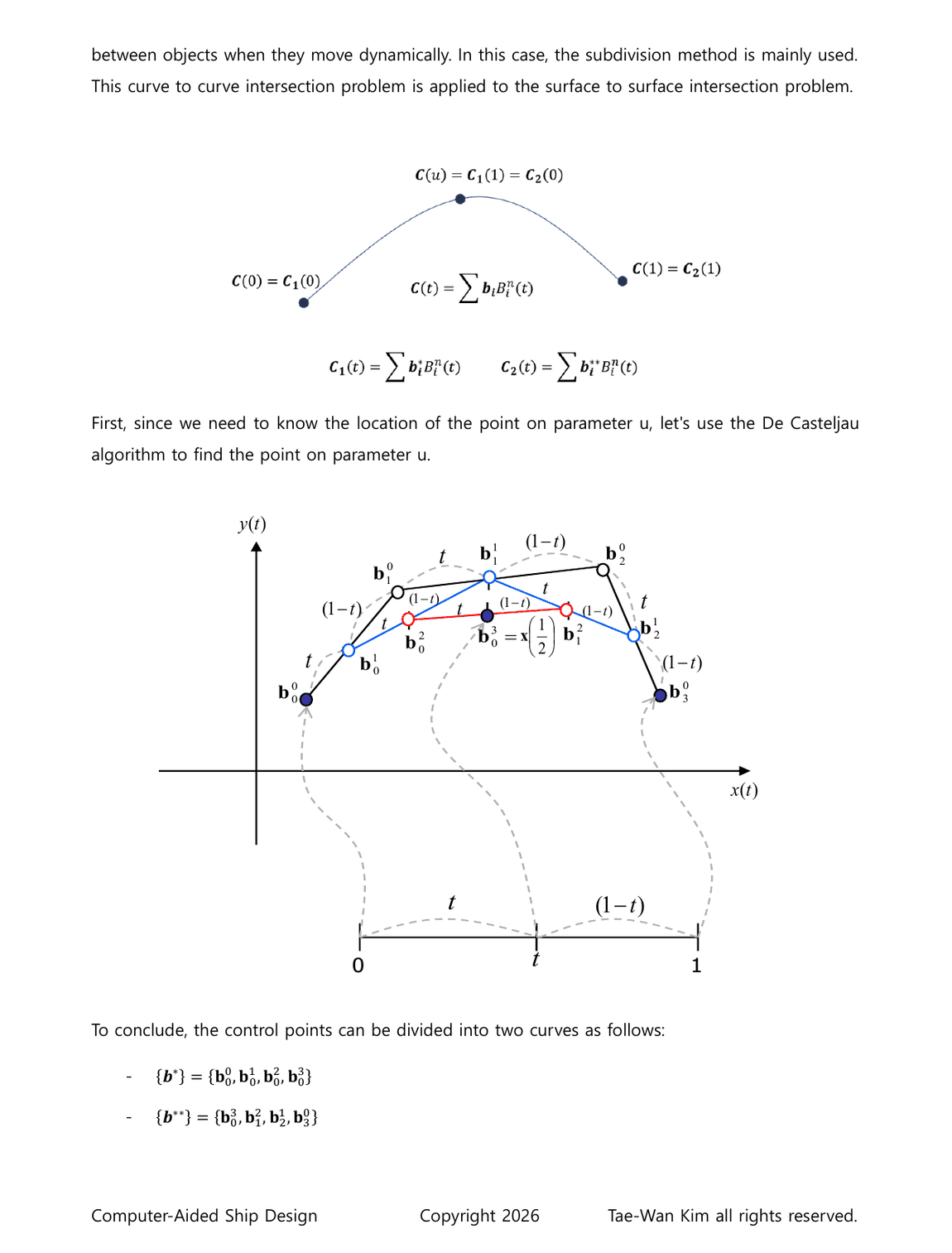
Reparameterization
Let $s\in[0,1]$.
Left curve
\[\mathbf{C}_{1}(s)=\mathbf{C}(us)\]Right curve
\[\mathbf{C}_{2}(s)=\mathbf{C}\big(u+(1-u)s\big)\]At the common endpoint,
\[\mathbf{C}_{1}(1)=\mathbf{C}(u)=\mathbf{C}_{2}(0)\]Clipping
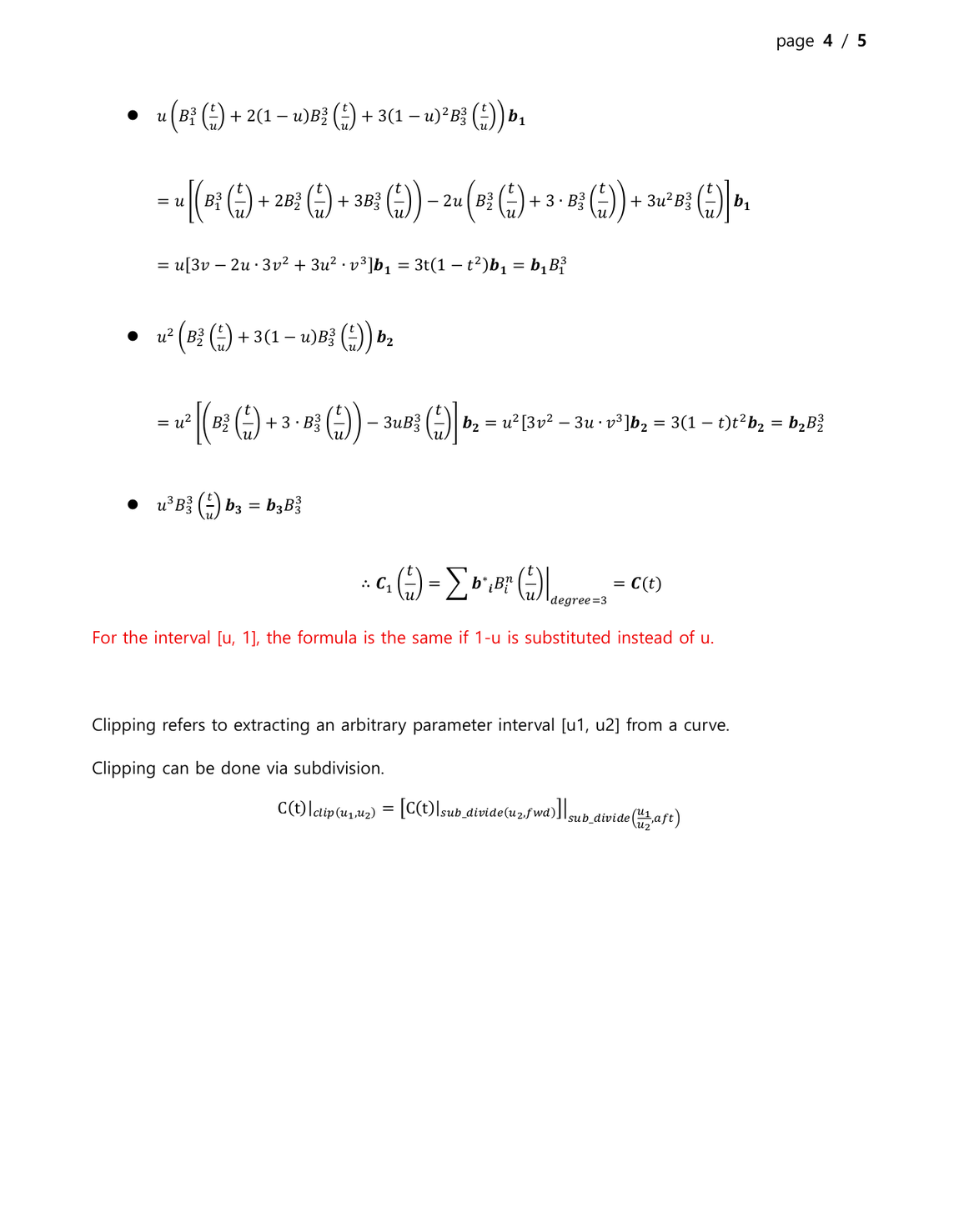
Clipping extracts an arbitrary parameter interval $[u_{1},u_{2}]$ from a curve. It can be performed by two subdivisions.
- Subdivide at $u_2$ and keep the forward part.
- Reparameterize the retained interval.
- Subdivide again at $u_1/u_2$ and keep the after part.
2. Degree Elevation
Degree elevation increases the degree of a Bézier curve without changing its shape.
\[\mathbf{C}(t) = \sum_{i=0}^{n}\mathbf{b}_{i}B_{i}^{n}(t) = \sum_{i=0}^{n+1}\mathbf{b}_{i}'B_{i}^{n+1}(t)\]Use
\[(1-t)+t=1\]to express the degree-$n$ basis in the degree-$(n+1)$ basis.
The elevated control points are
\[\mathbf{b}_{0}'=\mathbf{b}_{0}\] \[\mathbf{b}_{i}' = \frac{i}{n+1}\mathbf{b}_{i-1} + \frac{n+1-i}{n+1}\mathbf{b}_{i}, \qquad 1\le i\le n\] \[\mathbf{b}_{n+1}'=\mathbf{b}_{n}\]Degree $2$ to degree $3$
\[\mathbf{b}_{0}'=\mathbf{b}_{0}\] \[\mathbf{b}_{1}' = \frac{1}{3}\mathbf{b}_{0} + \frac{2}{3}\mathbf{b}_{1}\] \[\mathbf{b}_{2}' = \frac{2}{3}\mathbf{b}_{1} + \frac{1}{3}\mathbf{b}_{2}\] \[\mathbf{b}_{3}'=\mathbf{b}_{2}\]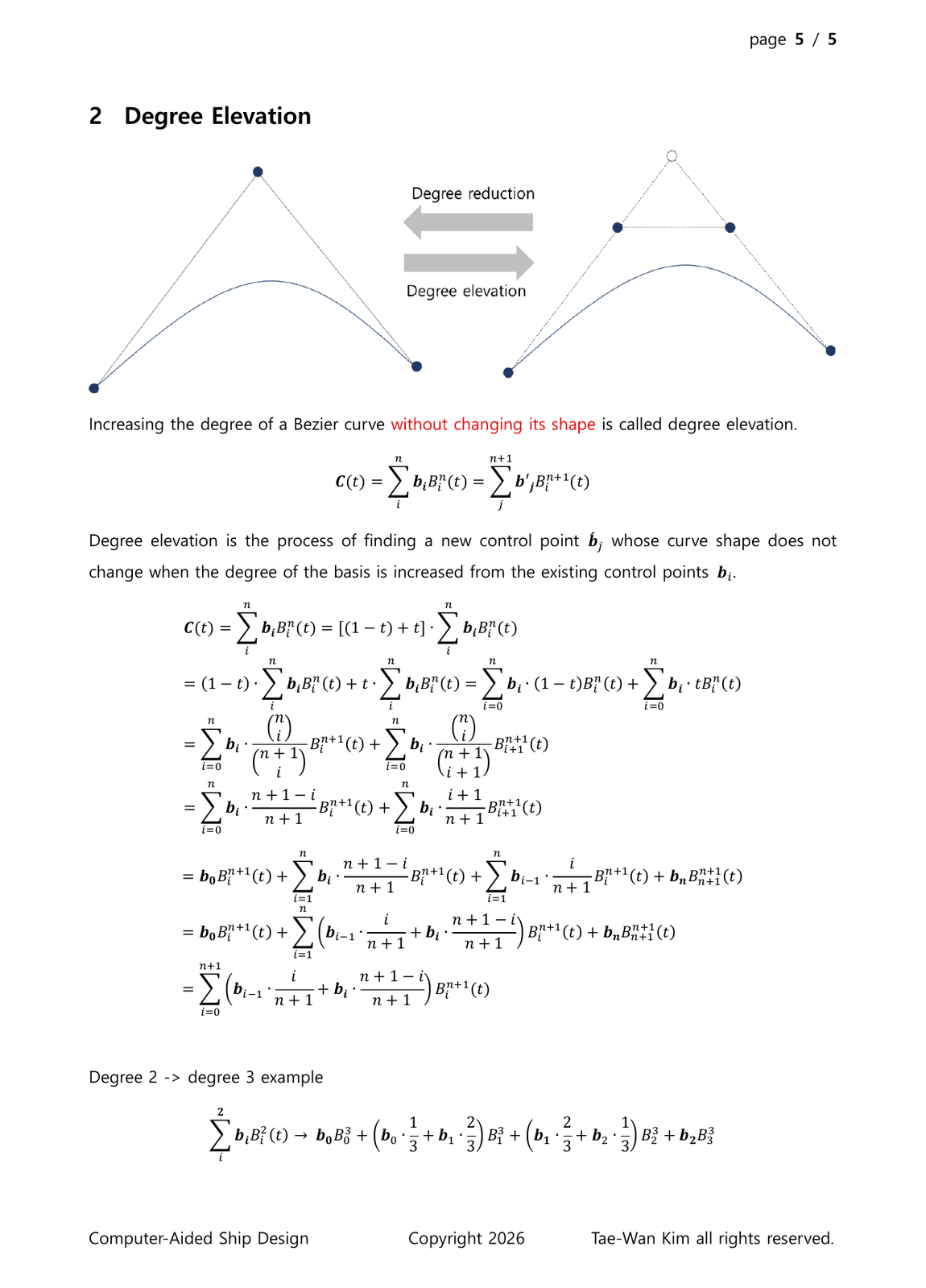
댓글을 불러오는 중입니다.