
[컴선설] Lec 10A C++ code for coons method
LN10A. C++ Code for a Coons Method
1. Code of de Casteljau Algorithm of a Triangular Coons Patch
The algorithm evaluates one coordinate of an $n$th-degree triangular Bézier patch at one barycentric coordinate $(u,v,w)$.
For degree $n$, the number of triangular control points is
\[N_{\mathrm{tri}}=\frac{(n+1)(n+2)}{2}\]For a cubic triangular net, use the following linear order.
\[\mathbf{b}_{300}, \mathbf{b}_{210}, \mathbf{b}_{201}, \mathbf{b}_{120}, \mathbf{b}_{111}, \mathbf{b}_{102}, \mathbf{b}_{030}, \mathbf{b}_{021}, \mathbf{b}_{012}, \mathbf{b}_{003}\]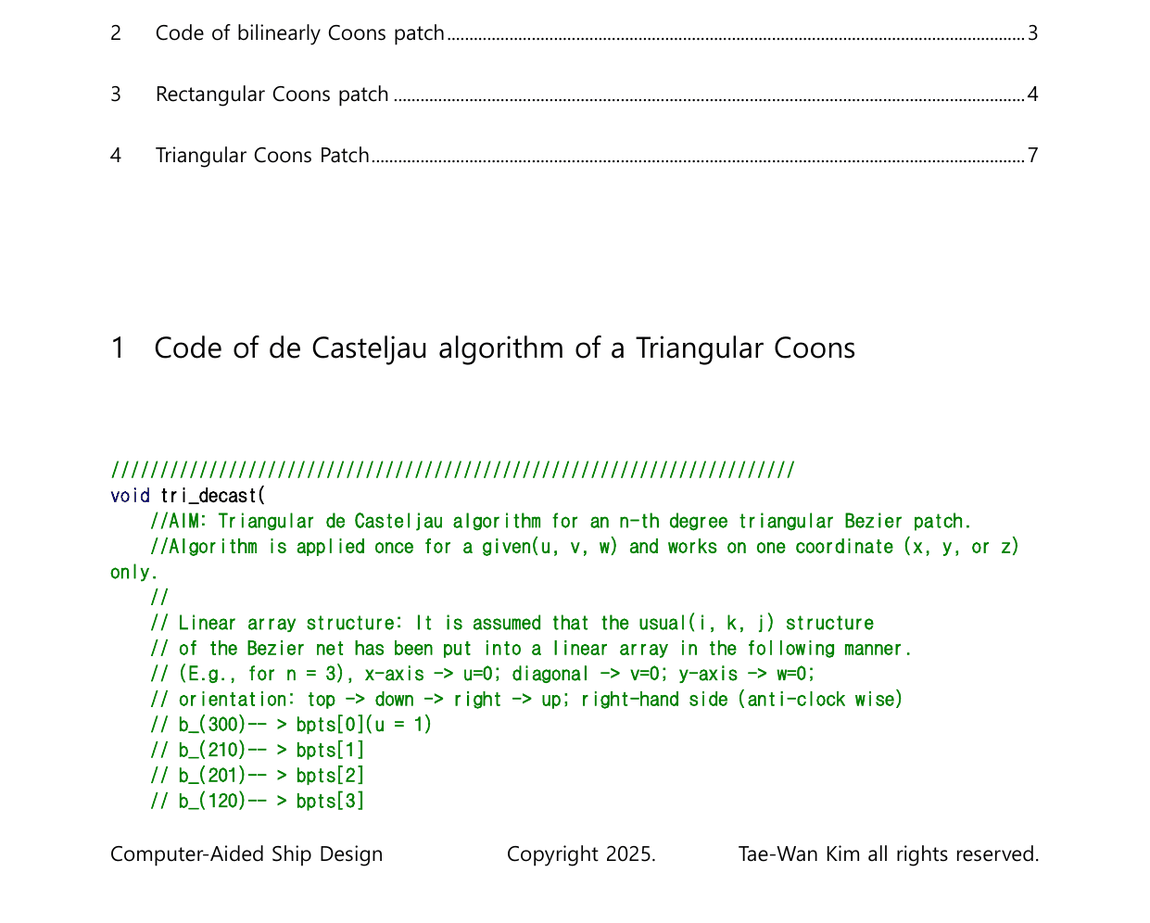
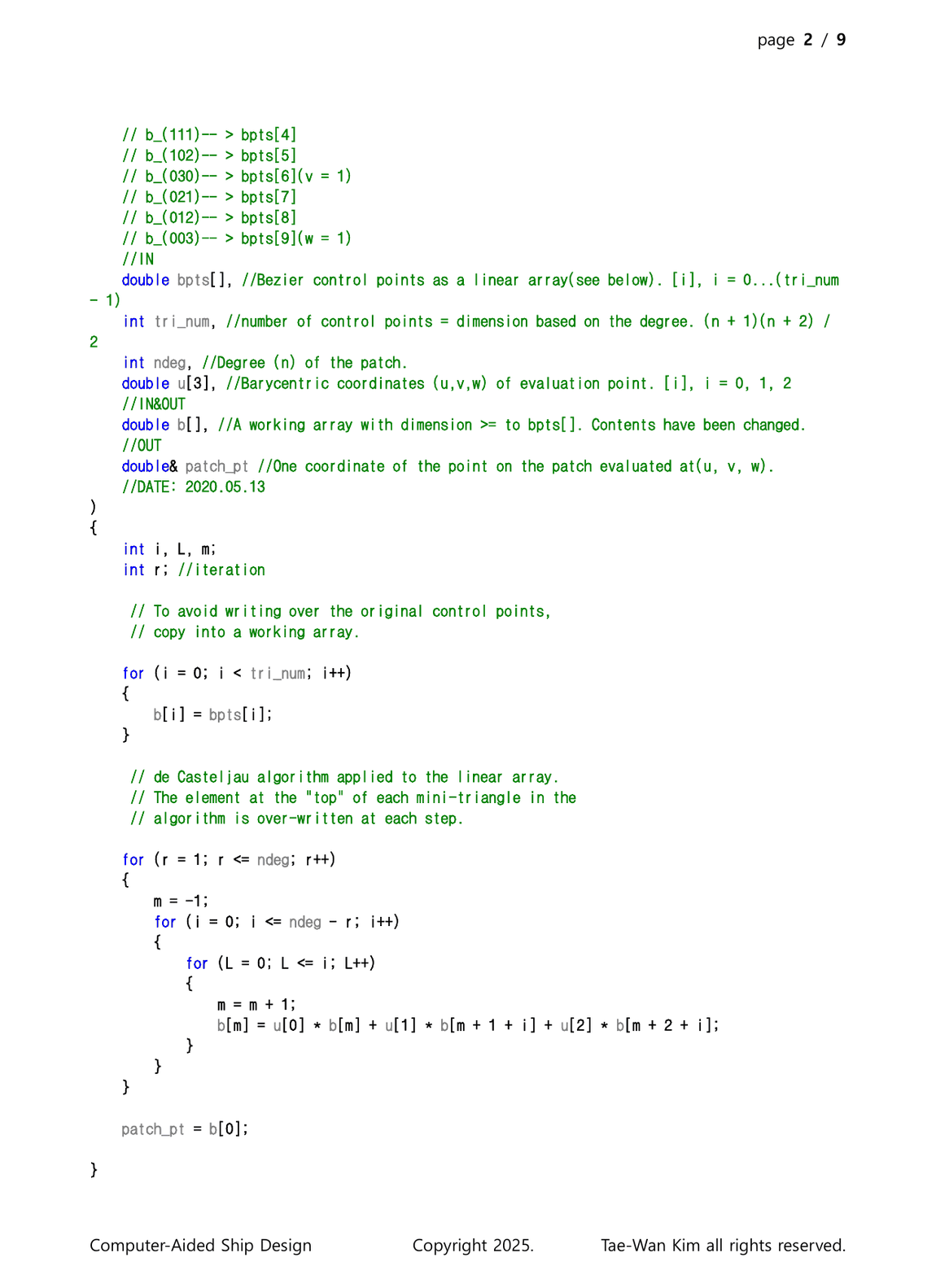
void tri_decast(
    double bpts[],
    int tri_num,
    int ndeg,
    double u[3],
    double b[],
    double& patch_pt)
{
    int i, L, m;
    int r;

    // Copy the original control points into the working array.
    for (i = 0; i < tri_num; i++) {
        b[i] = bpts[i];
    }

    // Apply triangular de Casteljau recursion.
    for (r = 1; r <= ndeg; r++) {
        m = -1;

        for (i = 0; i <= ndeg - r; i++) {
            for (L = 0; L <= i; L++) {
                m = m + 1;

                b[m] =
                    u[0] * b[m]
                    + u[1] * b[m + 1 + i]
                    + u[2] * b[m + 2 + i];
            }
        }
    }

    patch_pt = b[0];
}
2. Code of Bilinearly Coons Patch
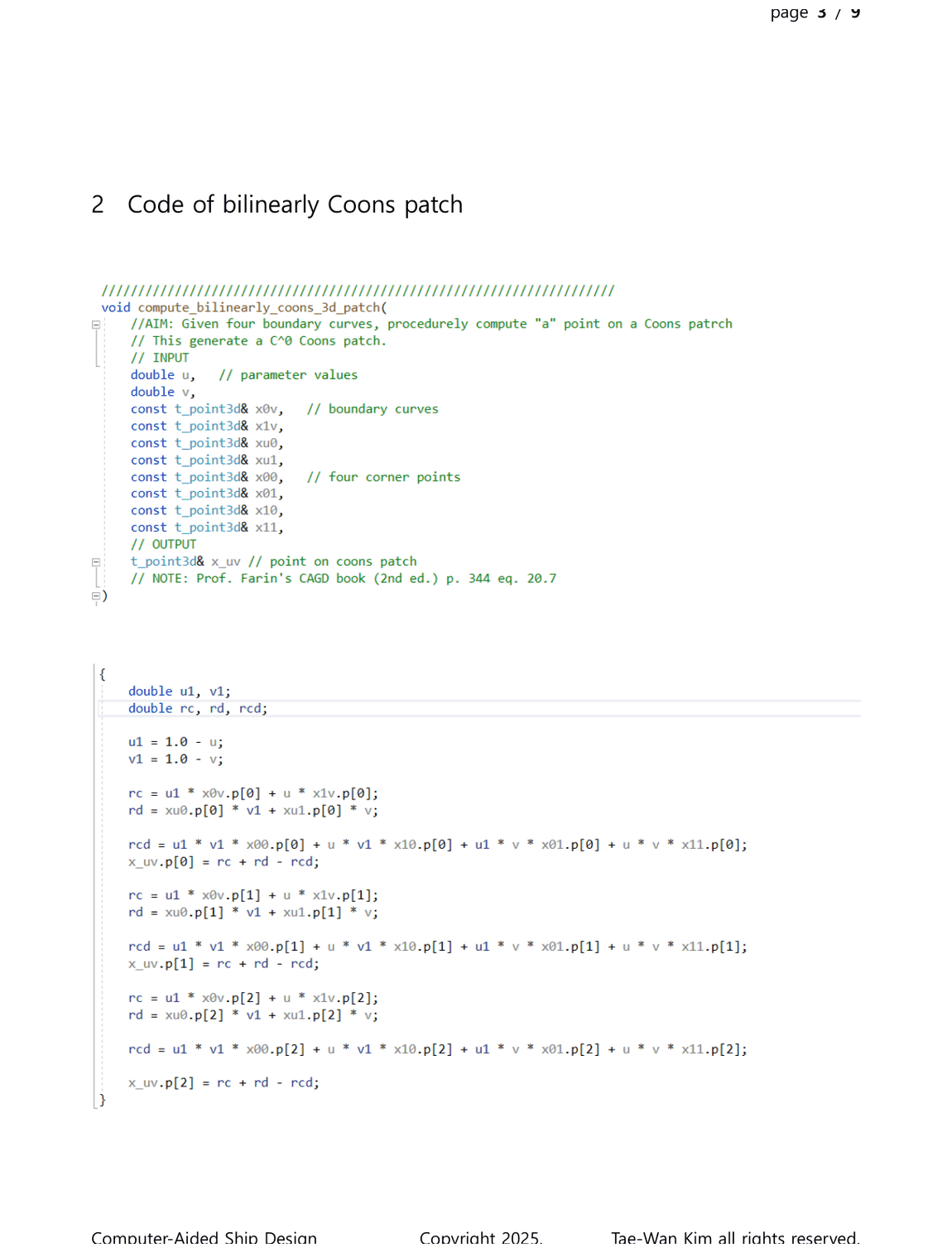
For four boundary curves, construct the two ruled surfaces and subtract the bilinear corner patch.
\[\mathbf{S}(u,v) = (1-v)\mathbf{b}(u)+v\mathbf{t}(u) +(1-u)\mathbf{l}(v)+u\mathbf{r}(v) -\mathbf{S}_{\mathrm{bilinear}}(u,v)\] \[\begin{aligned} \mathbf{S}_{\mathrm{bilinear}}(u,v) ={}&(1-u)(1-v)\mathbf{p}_{00} +u(1-v)\mathbf{p}_{10}\\ &+(1-u)v\mathbf{p}_{01} +uv\mathbf{p}_{11} \end{aligned}\]Point bilinearCoons(
double u,
double v,
const Curve& left,
const Curve& right,
const Curve& bottom,
const Curve& top)
{
Point Su = (1.0 - v) * bottom(u) + v * top(u);
Point Sv = (1.0 - u) * left(v) + u * right(v);
Point corner =
(1.0 - u) * (1.0 - v) * bottom(0.0)
+ u * (1.0 - v) * bottom(1.0)
+ (1.0 - u) * v * top(0.0)
+ u * v * top(1.0);
return Su + Sv - corner;
}
3. Rectangular Coons Patch
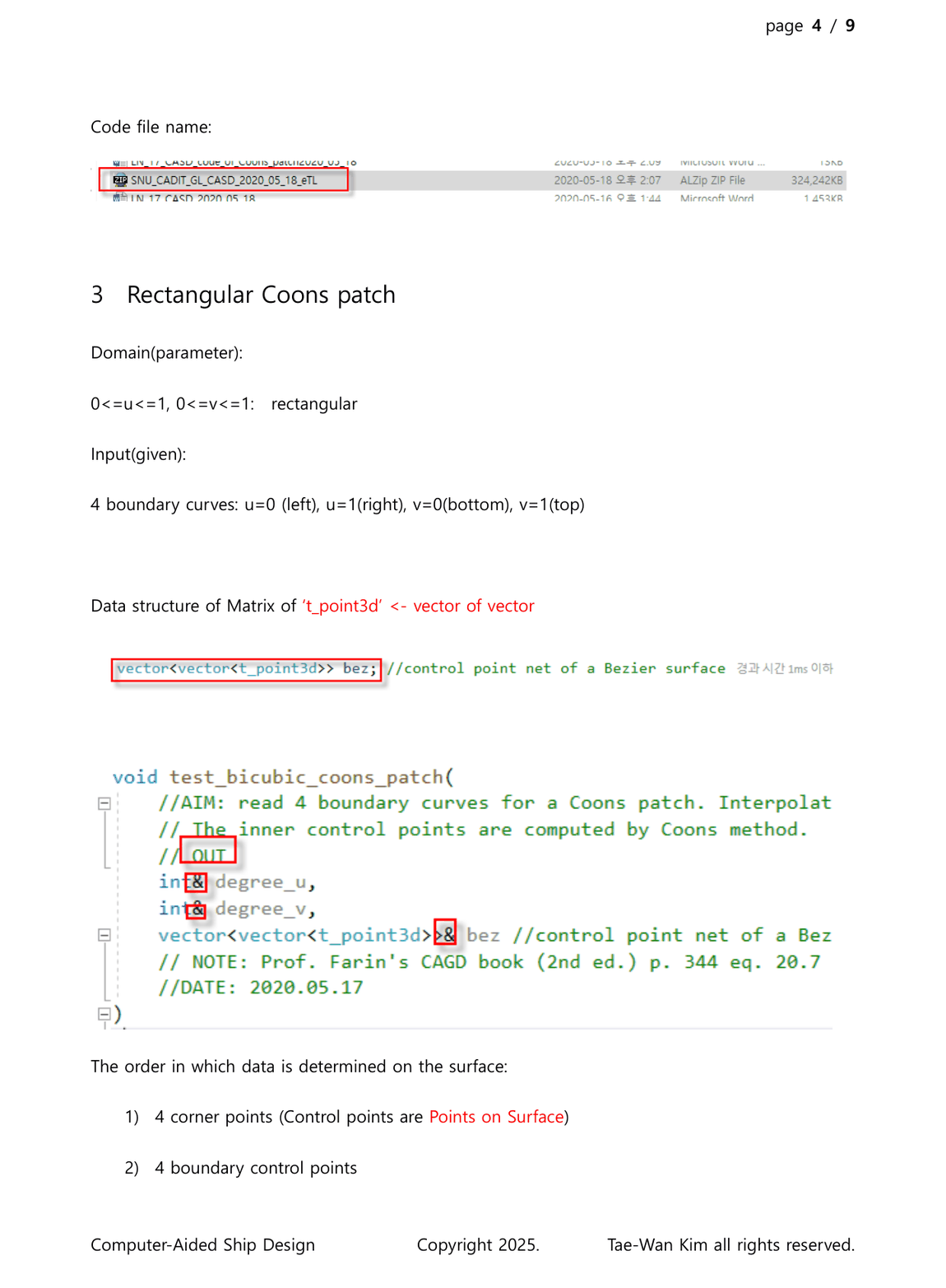
Parameter domain
\[0\le u\le1, \qquad 0\le v\le1\]Input
- $u=0$: left boundary
- $u=1$: right boundary
- $v=0$: bottom boundary
- $v=1$: top boundary
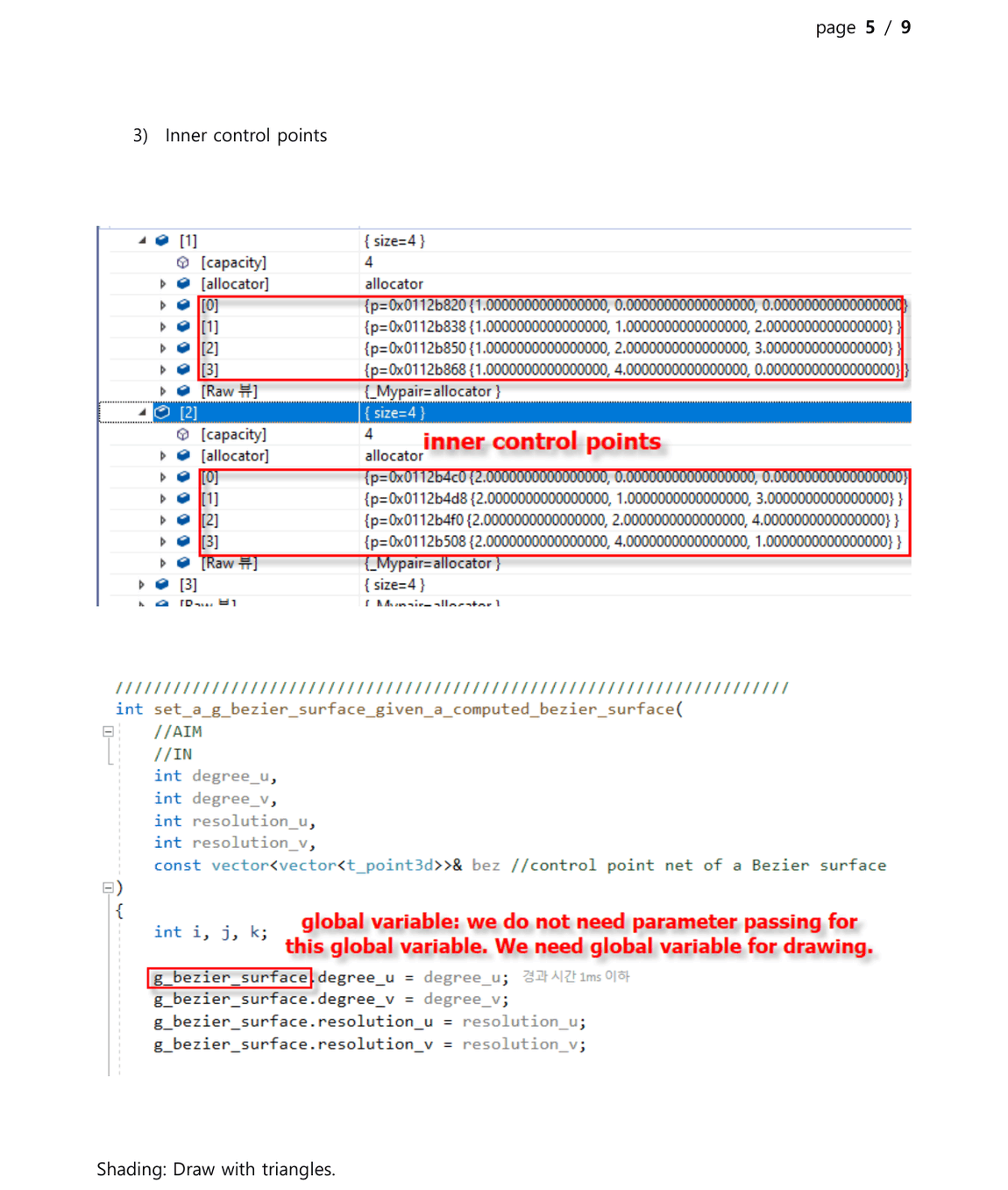
Use a matrix represented by a vector of vectors.
std::vector<std::vector<t_point3d>> control_points;
Determine the surface data in the following order.
- Four corner control points, which are points on the surface.
- Boundary control points.
- Inner control points computed by the Coons method.
Shading
- Flat shading
- One normal vector per triangle.
- Same color over the triangle.
- Lowest quality and fastest speed.
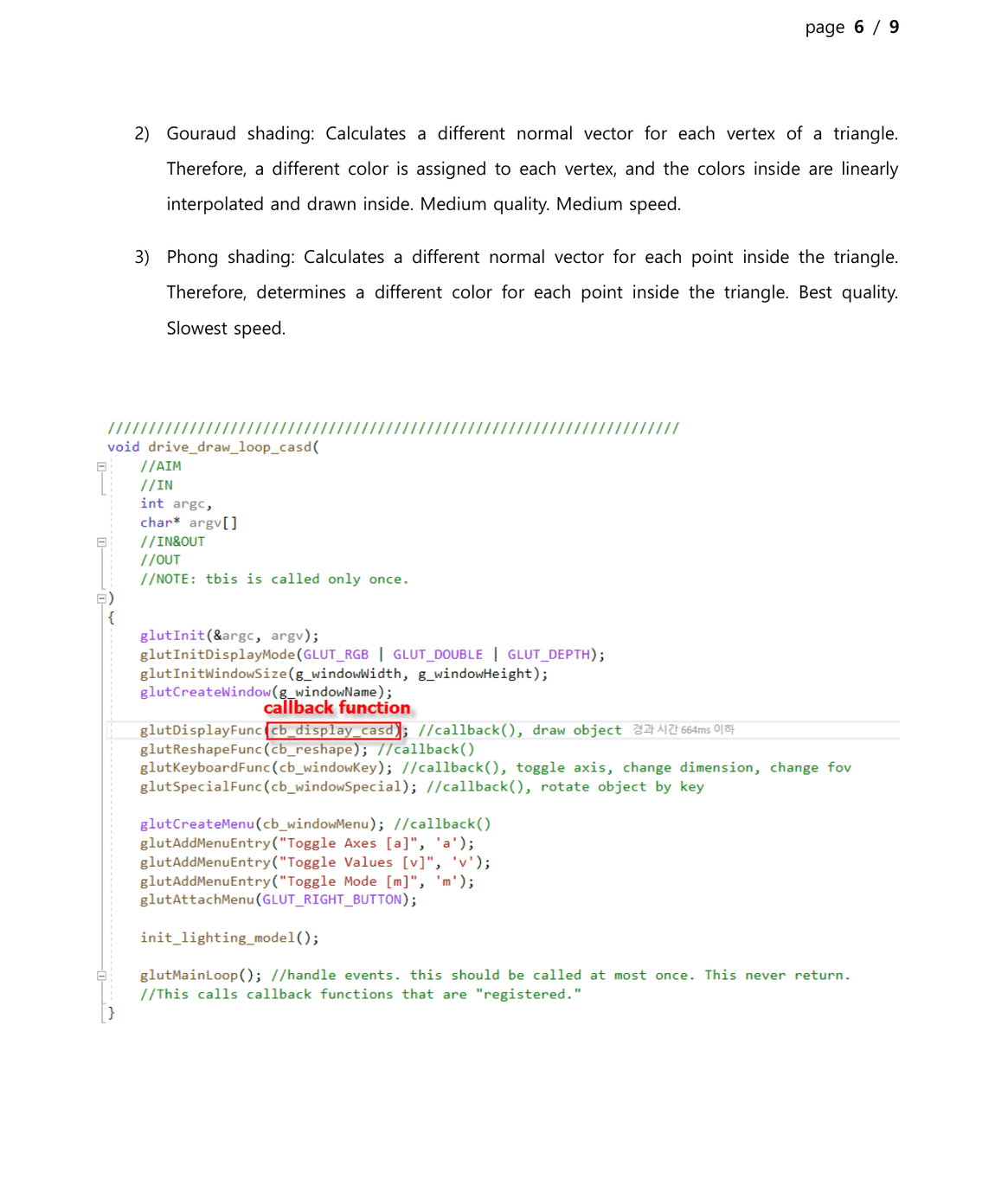
- Gouraud shading
- One normal vector per vertex.
- Vertex colors are linearly interpolated over the triangle.
- Medium quality and medium speed.
- Phong shading
- Interpolate the normal and evaluate lighting at every point.
- Highest quality and slowest speed.
4. Triangular Coons Patch
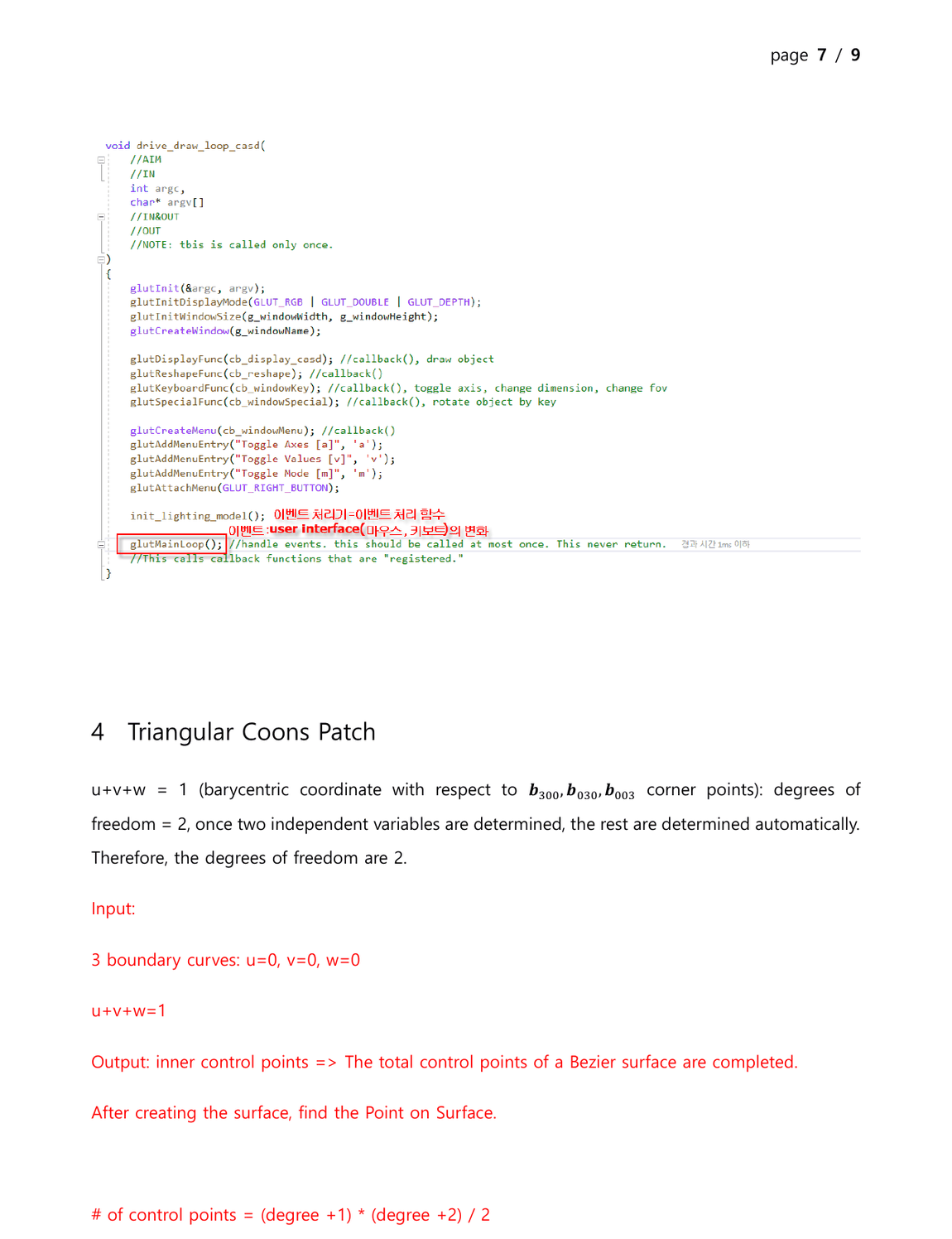
Barycentric coordinates
\[u+v+w=1\]The parameter domain has two degrees of freedom.
Input
- three boundary curves: $u=0$, $v=0$, and $w=0$,
- barycentric coordinates satisfying $u+v+w=1$.
Output
- the inner control points,
- the completed triangular Bézier control net,
- a point on the surface after evaluation.
For degree $3$,
\[N_{\mathrm{control}} = \frac{4\cdot5}{2}=10\]Nine boundary control points are given, so the unknown point is $\mathbf{b}_{111}$.
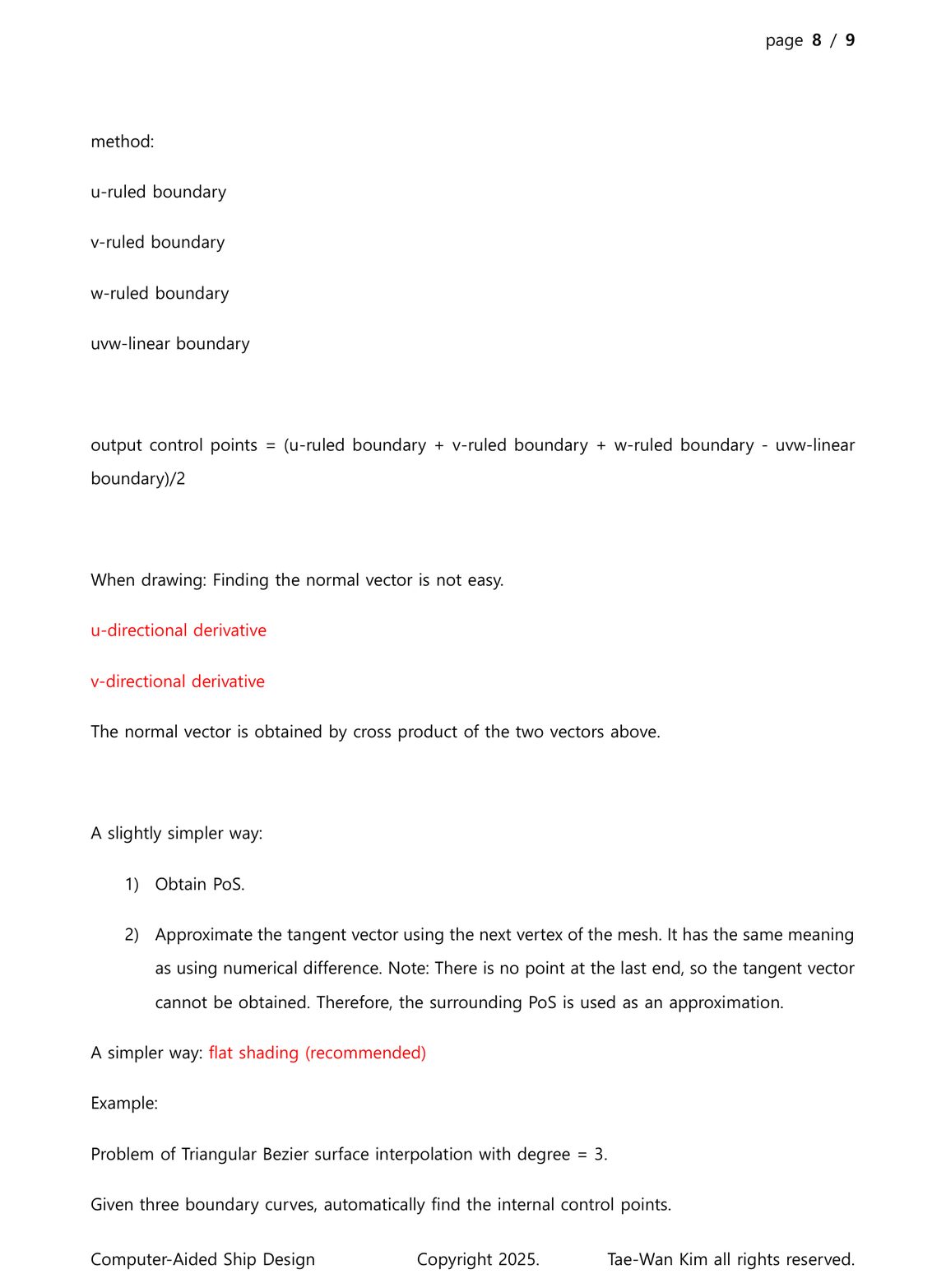
Construct
- the $u$ruled boundary patch,
- the $v$ruled boundary patch,
- the $w$ruled boundary patch,
- the $uvw$linear patch.
The surface normal can be obtained from two directional derivatives.
\[\mathbf{n} = \frac{\mathbf{S}_{u}\times\mathbf{S}_{v}} {\|\mathbf{S}_{u}\times\mathbf{S}_{v}\|}\]A simpler implementation is
- evaluate points on the surface,
- approximate tangent vectors by finite differences between neighboring mesh points,
- use the cross product, or use flat shading directly.
댓글을 불러오는 중입니다.